Temporal Superimposed Crossover Module for Effective Continuous Sign Language
essay: https://arxiv.org/pdf/2211.03387.pdf
I. Core Idea
- Temporal Superimposed Crossover Module (TSMC): zero parameter, zero computation.
- TSMC + 2D Conv: combines it with 2D convolution to form a "TSCM+2D convolution" hybrid convolution, strong spatial-temporal modelling capability.
- The hybrid convolution of ”TSCM+2D convolution” is applied to the ResBlock of the ResNet network to form the new ResBlockT.
- random gradient stop and multilevel CTC loss
II. Relative Work
VSLR is the translation of continuous sign language videos into comprehensible written phrases or spoken words. While traditional methods usually extract manual features and then combine them with HMM[6][18] or dynamic time warping (DTW)[19] methods, the rise of CNNs has replaced the extraction of manual features.
III. METHODOLOGY
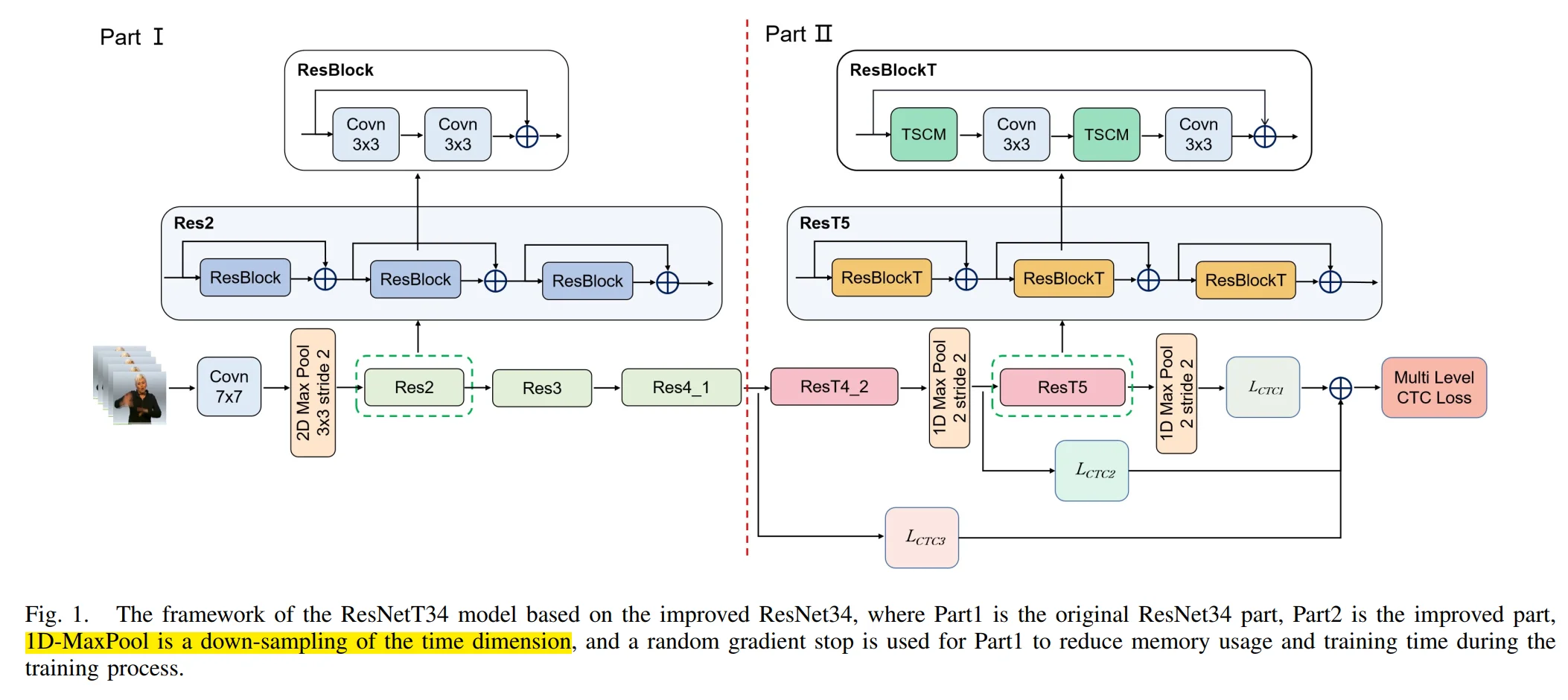
3.1 TSCM
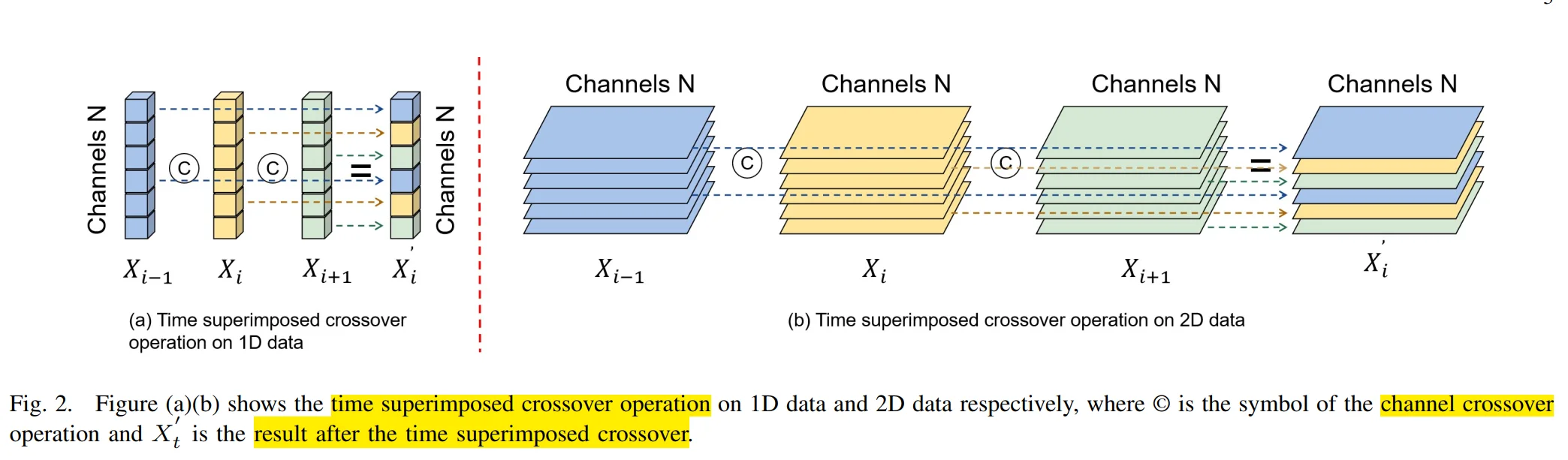
3.1.1 Temporal Superposition 的计算方法
(1) Channel Dilation and Conv
use a 1D convolution with a convolution kernel of size 1, an input channel number that is expanded by a factor of n (n is the number of superimposed data), and an output channel number that remains the same as the channel number of the original data Xi
Kernel: \(W = [\omega_1, \omega_2, \omega_3]\) (Concat in the channel dimension)
\(X_{i}\) shape: \((C, H, W)\), \(\omega_{i}\) is a scalar, and \(Y_{i}^{\prime}\) shape: \((C, H, W)\).
上述操作直接等效于先把三个张量在通道维度上 concat,然后再进行一个卷积核大小为1的卷积操作,卷积核的输入通道数是原来数据通道数的3倍,输出通道数与原来数据通道数相同。
Defect: It will cause a sharp increase in the amount of calculation and parameters.
(2) Channel Partial Stacking
三个张量,每一个选出 \(C/n\) 个通道进行拼接,得到一个新的张量 \(Y_{i}^{\prime}\),其 shape 仍然是 \((C, H, W)\)。
3.1.2 Channel Crossover
在 concat 的时候采用梳状排列,即:
\(X_{i-1} = [x_{1}^{i-1}, x_2^{i-1}, \ldots, x_{N}^{i-1}]\)
\(X_{i} = [x_{1}^{i}, x_2^{i}, \ldots, x_{N}^{i}]\)
\(X_{i+1} = [x_{1}^{i+1}, x_2^{i+1}, \ldots, x_{N}^{i+1}]\)
\(\Rightarrow\)
\(X_{i}^{\prime} = [x_{1}^{i-1}, x_2^{i}, x_{3}^{i+1}, \cdots x_{N-2}^{i-1}, x_{N-1}^{i}, x_{N}^{i+1}]\)
然后再做 \(1 \times 1\) 卷积
3.1.3 TSCM Example
假设输入张量维度为 \(5 \times 6 \times 1 \times 1\)(\(T=5, C=6\)),每一帧的原始通道特征表示为:
- \(X_1\): \([x^1_1, x^1_2, x^1_3, x^1_4, x^1_5, x^1_6]\)
- \(X_2\): \([x^2_1, x^2_2, x^2_3, x^2_4, x^2_5, x^2_6]\)
- \(X_3\): \([x^3_1, x^3_2, x^3_3, x^3_4, x^3_5, x^3_6]\)
- \(X_4\): \([x^4_1, x^4_2, x^4_3, x^4_4, x^4_5, x^4_6]\)
- \(X_5\): \([x^5_1, x^5_2, x^5_3, x^5_4, x^5_5, x^5_6]\)
按照论文中 1/3 通道比例 进行梳状交叉混合(Comb-like crossover)的最优配置,TSCM 处理后的输出序列 \(X'\) 如下:
1. 中间帧的处理(以第 3 帧 \(X'_3\) 为例)
对于中间帧,它会同时吸收前一帧(\(X_2\))和后一帧(\(X_4\))的信息。
- 通道 1, 4:替换为 \(X_2\) 的对应通道。
- 通道 2, 5:保留 \(X_3\) 的原始通道。
- 通道 3, 6:替换为 \(X_4\) 的对应通道。
\(X'_3\) 的最终形式:
2. 整个序列 \(T=5\) 的变化预览
通过这种位移与交叉操作,整个序列在通道层面发生了如下“演变”:
| 时间步 | 经过 TSCM 处理后的通道构成 (由哪一帧提供) | 物理意义 |
|---|---|---|
| \(X'_1\) | \([0, X_1, X_2, 0, X_1, X_2]\) (边界补零) | 仅能感知当前与未来 |
| \(X'_2\) | \([X_1, X_2, X_3, X_1, X_2, X_3]\) | 感知过去、现在与未来 |
| \(X'_3\) | \([X_2, X_3, X_4, X_2, X_3, X_4]\) | 感知过去、现在与未来 |
| \(X'_4\) | \([X_3, X_4, X_5, X_3, X_4, X_5]\) | 感知过去、现在与未来 |
| \(X'_5\) | \([X_4, X_5, 0, X_4, X_5, 0]\) (边界补零) | 仅能感知过去与当前 |
IV. Effect
4.1 Accuary
- RWTH: As can be seen in Table I, the model proposed in this paper achieves highly competitive result on the RWTH compared to other state-of-the-art models, with a WER of 21.1% on both the validation and test sets.
- CSL: Table II shows that the proposed model also achieves competitive result on the CSL, with a WER of 26.4% on the test set.
4.2 Model Size
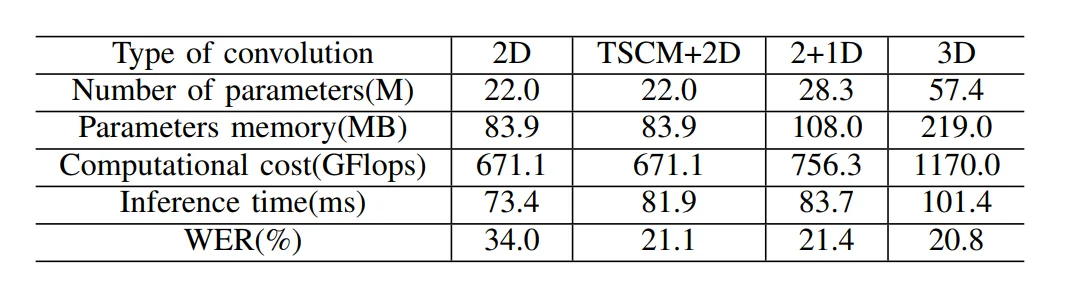
TSCM 参数量为 80 MB 左右,远超于 A1 NPU 支持的 10MB 不可用
此外,TSCM 的输入模态是 RGB 视频,也无法直接应用到我们的系统
V. 可以借鉴的点
- Channel Crossover: 通过梳状排列的方式进行通道交叉混合,增强了模型对时序信息的感知能力。
- Multilevel CTC Loss: 在不同层次上引入 CTC 损失,促进模型在不同抽象层次上学习更有效的特征表示。